Transforming the mobile financial experience for accommodation partners.
Pulse is Booking.com's operational mobile app for hosts and accommodation partners. For its smallest partners, financial management is the single most critical job the app has to do, and the mobile experience wasn't keeping up.

Overview
Pulse is Booking.com's operational mobile app for hosts and accommodation partners. For "Small Home Partners," financial management is their single most critical job, with over 80% describing it as essential and scoring its importance 8/10 in internal fintech research.
Problem
The mobile financial experience lagged severely behind the web portal. Crucial features were missing or poorly adapted for mobile, creating persistent operational friction and driving high support costs.
- Support burden: €2M+ spent annually on finance-related support tickets (missing bank details, invoices, payout tracking).
- High churn risk: 28.9% of departing partners cited the platform as "too complicated" in exit surveys.
- Competitive gap: app store reviews and feedback showed growing frustration, with partners comparing Pulse unfavorably to Airbnb and Vrbo.
Goals & metrics
We launched with high-level directional goals: closing desktop parity, tapping into native mobile capabilities, and improving the financial experience for smaller accommodation partners. At the time, formal KPIs had not yet been established.
To create accountability and measure impact, we defined an initial measurement proxy strategy using standard FinTech benchmarks and early engagement signals while analytics infrastructure was being matured.
- Reduce operational costs: tracked via % reduction in finance-related CS tickets.
- Minimize payout failures: tracked via reduction in partners with missing details.
- Drive feature adoption: tracked via increase in financial page views and navigation clicks.
My role
I led end-to-end design strategy for the Pulse Payments program alongside PM and EM and drove research synthesis, roadmap prioritization, and design execution of our 3 MVP projects.
Confidentiality note: To comply with my non-disclosure agreement, I have omitted confidential information in this case study. The nature of this work is strictly confidential. Please don't disclose or use this information other than reviewing my work.
Discovery
We began with a broad brief: "Fix the mobile financial experience." To ground our roadmap in data, we launched a discovery phase combining quantitative metrics with qualitative insights to understand why satisfaction was declining and tickets were rising.
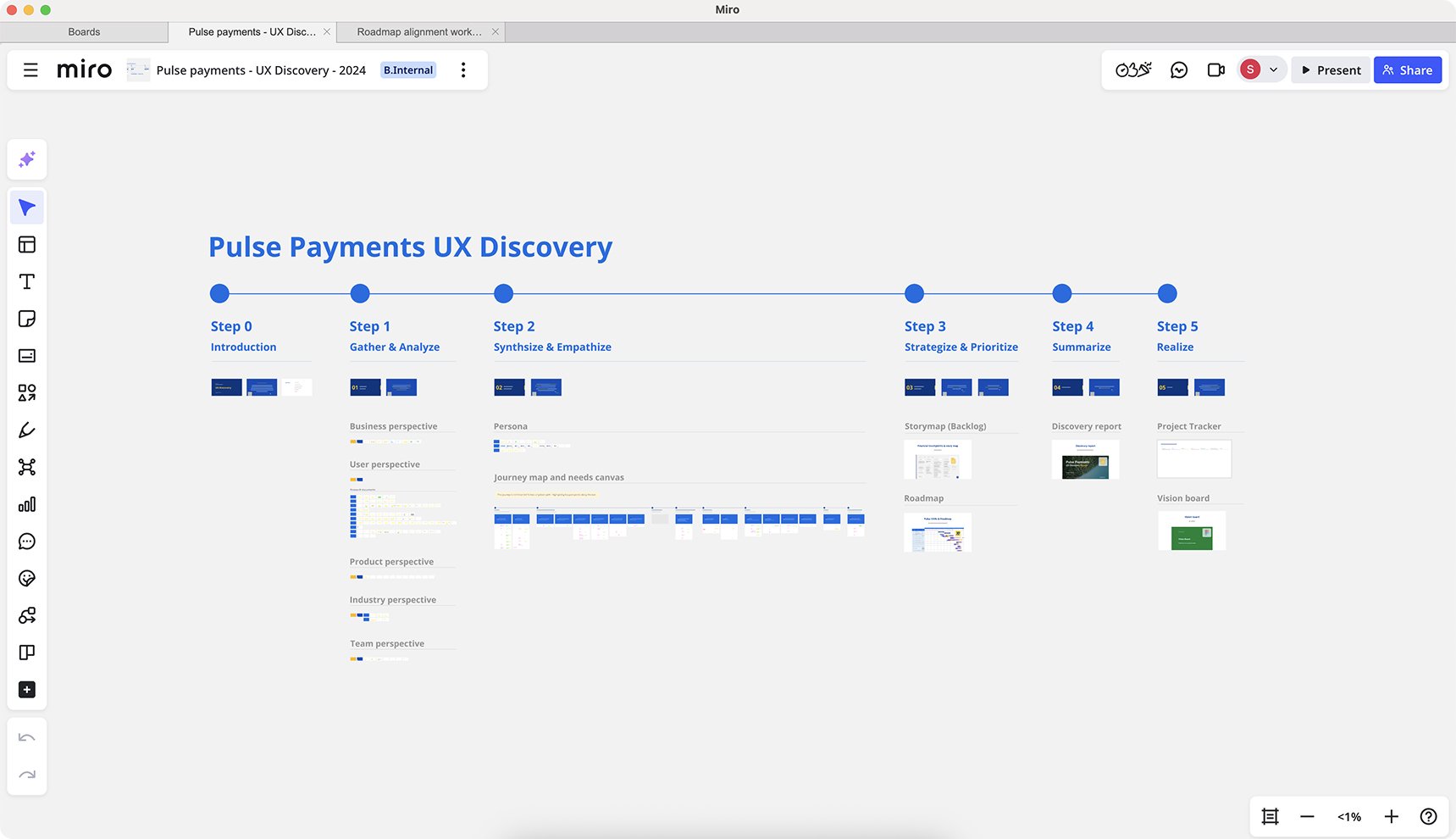
Method #1: UX audit
Assessed the existing app against native mobile heuristics to uncover usability friction, navigation bottlenecks, and desktop feature gaps.
Method #2: Desk & data research
Synthesized insights across app store reviews, partner feedback tools, CS ticket logs, Google Analytics, social listening, and existing internal FinTech research.
Strategy
Following comprehensive user research, we mapped partner pain points across their journey on Pulse. We then ran a workshop to brainstorm solutions and used an Effort vs. Impact matrix to select the best ideas for our MVP.
Partner journey: Paulo's experience
Get onboarded, finish setup & go live
Paulo onboards to Pulse, discovers payment products, and completes his financial setup to go live.
New partners struggle with setup tasks. Crucial steps like entering bank details get buried under other tasks, leading to delayed or blocked payouts.
A high-visibility onboarding checklist on the homepage to highlight critical setup tasks right away (including bank details entry as a priority).
Manage bookings
Paulo starts receiving and managing bookings.
When partners receive a booking, they don't understand how or when they will get paid.
Showcase payout status directly on the booking details page, using it as a key touchpoint to alert partners if bank details are missing.
Receive payouts
Paulo starts receiving payouts for his bookings.
Partners lack real-time updates on their payout status, forcing them to check the app manually.
Proactive notifications for key payout status updates, such as when a payout is sent, when an outage occurs, or when a payout fails due to missing bank details.
Reconcile payouts
Paulo checks to make sure all incoming and outgoing amounts are correct.
Financial info is fragmented across pages with poor mobile usability and no booking-level breakdowns for commissions, fees, and taxes, making reconciliation slow, error-prone, and reliant on manual workarounds.
A redesigned Payout Info page optimized for mobile, providing partners unified financial reporting for end-to-end payout clarity and reconciliation at the reservation level.
Get support
Paulo reaches out to support when a financial discrepancy arises.
No finance-specific help content is available, and support options are hidden or disconnected from workflows, forcing partners to escalate to customer service.
Out of MVP scope (high effort, low frequency of use). Ideas like AI troubleshooting, in-app ticketing, and a dedicated finance help page were deprioritized.
Monitor growth
Paulo reflects on his overall financial health and plans ahead.
Current financial tools only show a basic payout list without analytics, cash flow forecasting, or actionable insights to help partners understand performance or plan cash flow.
Out of MVP scope (high effort, low frequency of use). Ideas like finance dashboards and cash flow forecasts were deprioritized.
Execution
We executed three targeted MVP projects, validating designs through A/B and qualitative testing.
Project 1: Financial setup module
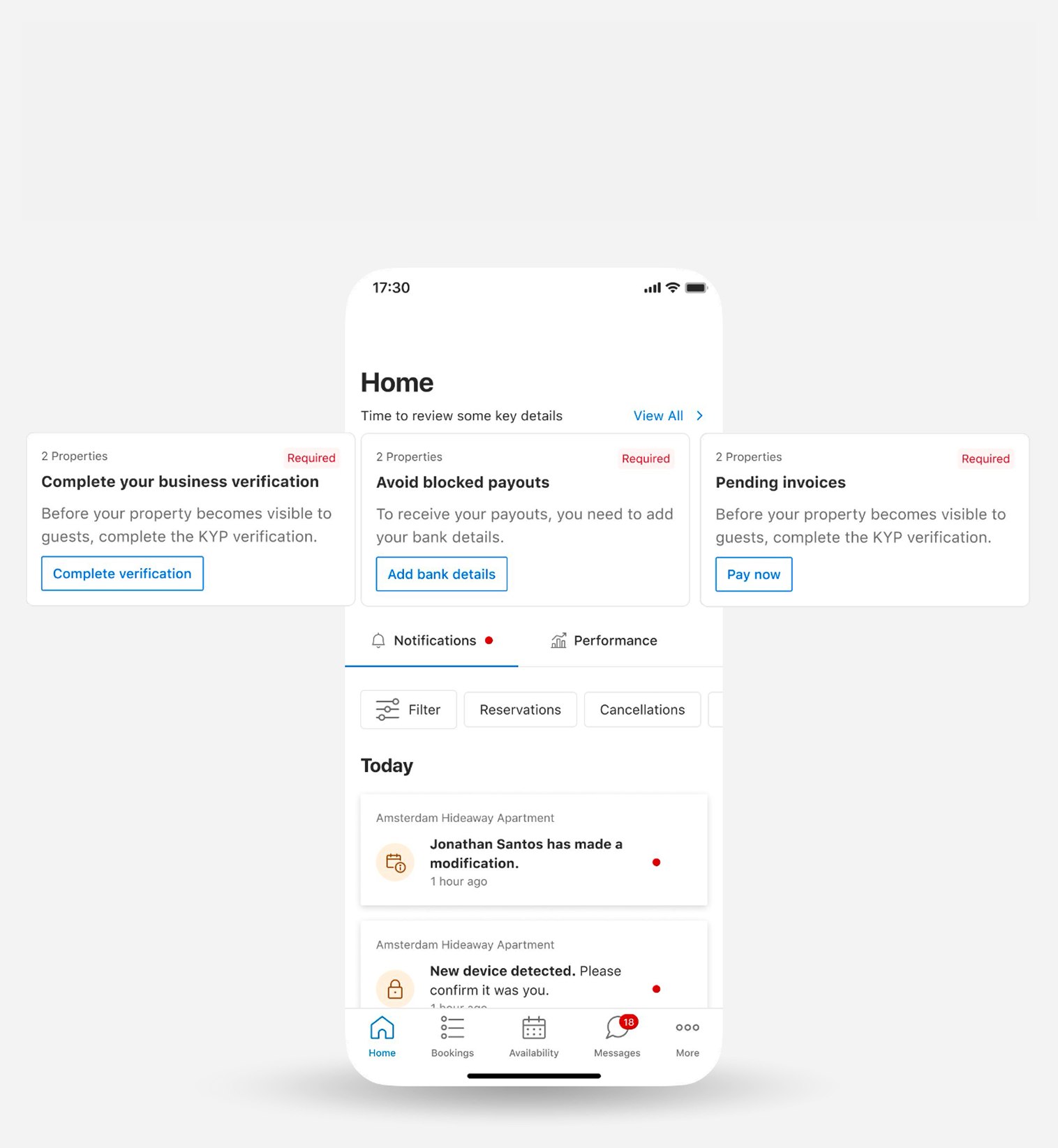
Solution: designed a high-visibility onboarding card on the Pulse homepage featuring progressive disclosure input patterns and inline validation for bank details. Added the same messaging on booking details.
Outcome: yielded a +5% increase in properties with complete bank details and reduced blocked payout for new partners.
Project 2: Financial communication & alerts
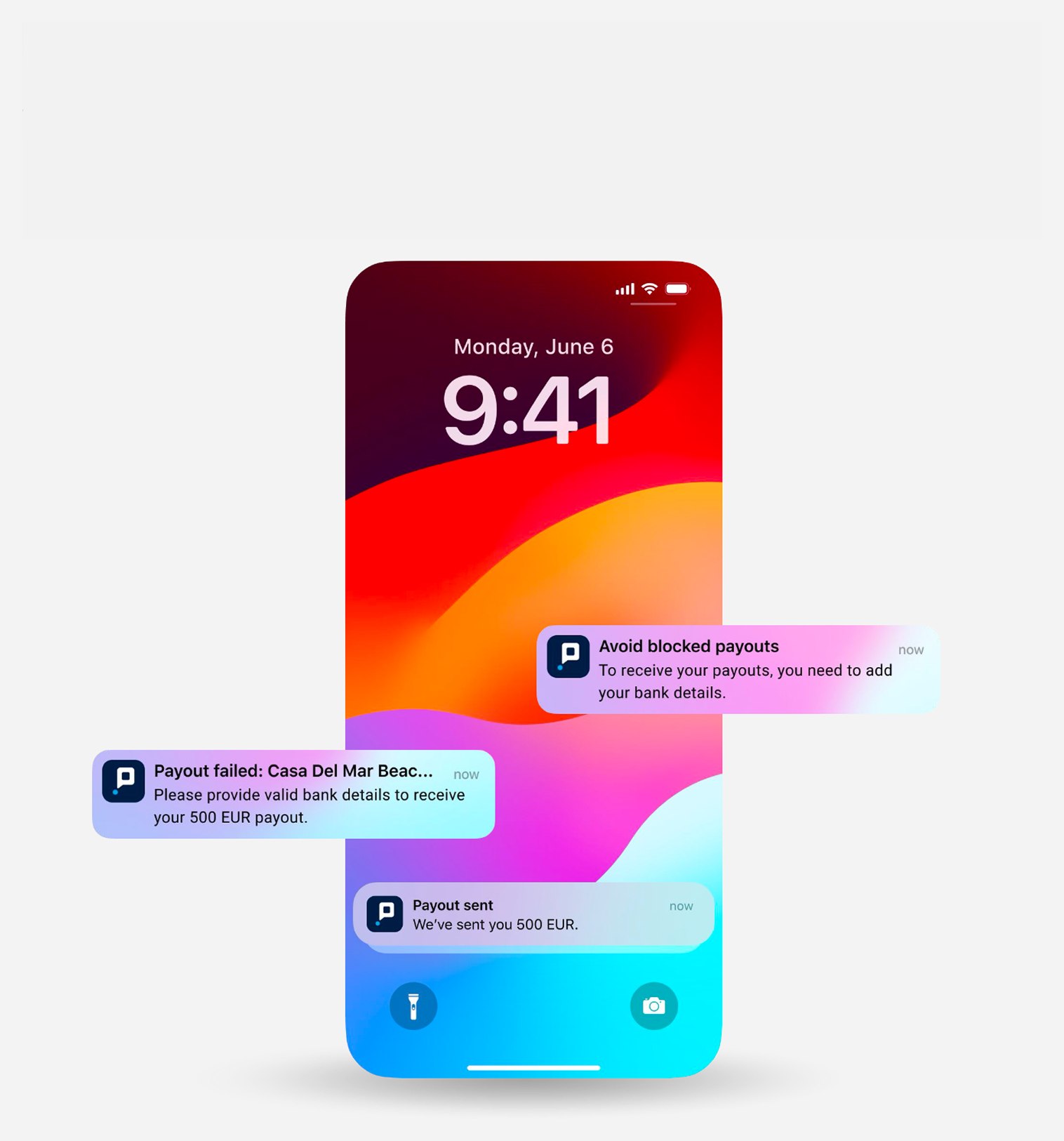
Solution: created a system of proactive push notifications and in-app alerts that deep-linked directly to high-friction resolution flows (e.g., updating expired credentials).
Outcome: significantly reduced resolution time for blocked payouts and boosted daily active user engagement on financial pages.
Project 3: Reporting & reconciliation (Payout Info revamp)
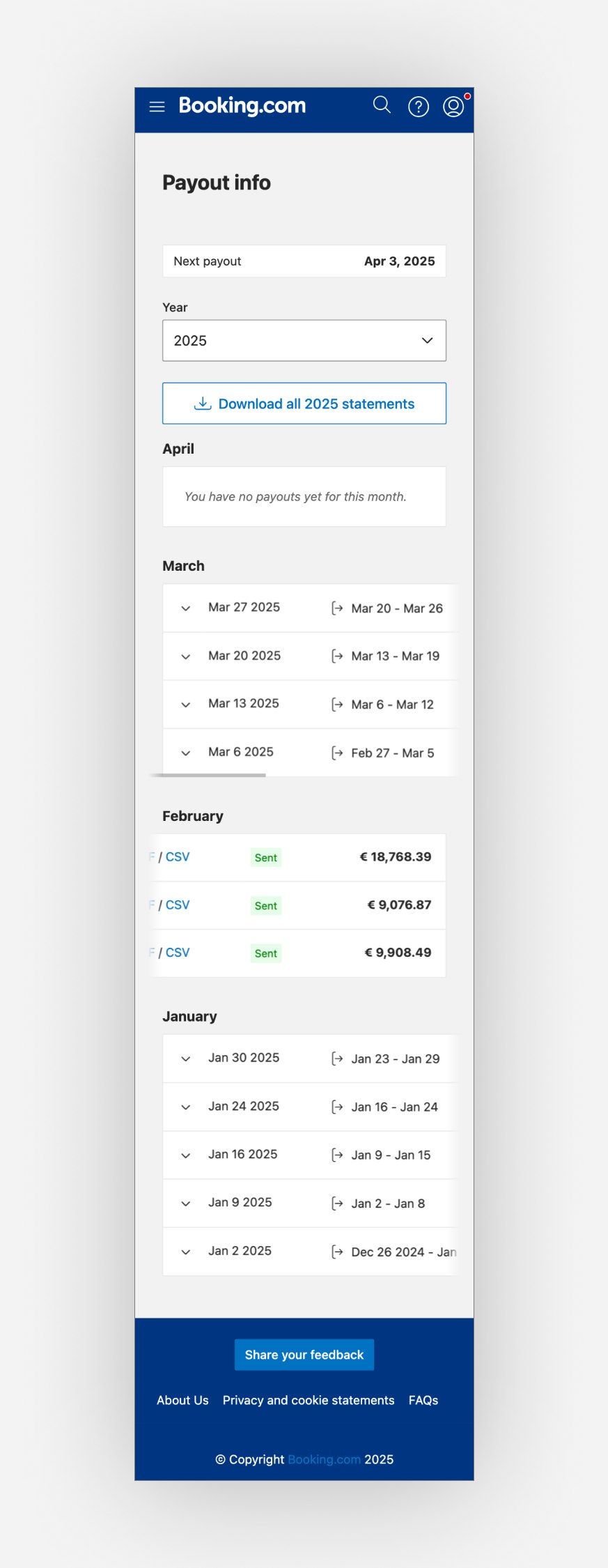
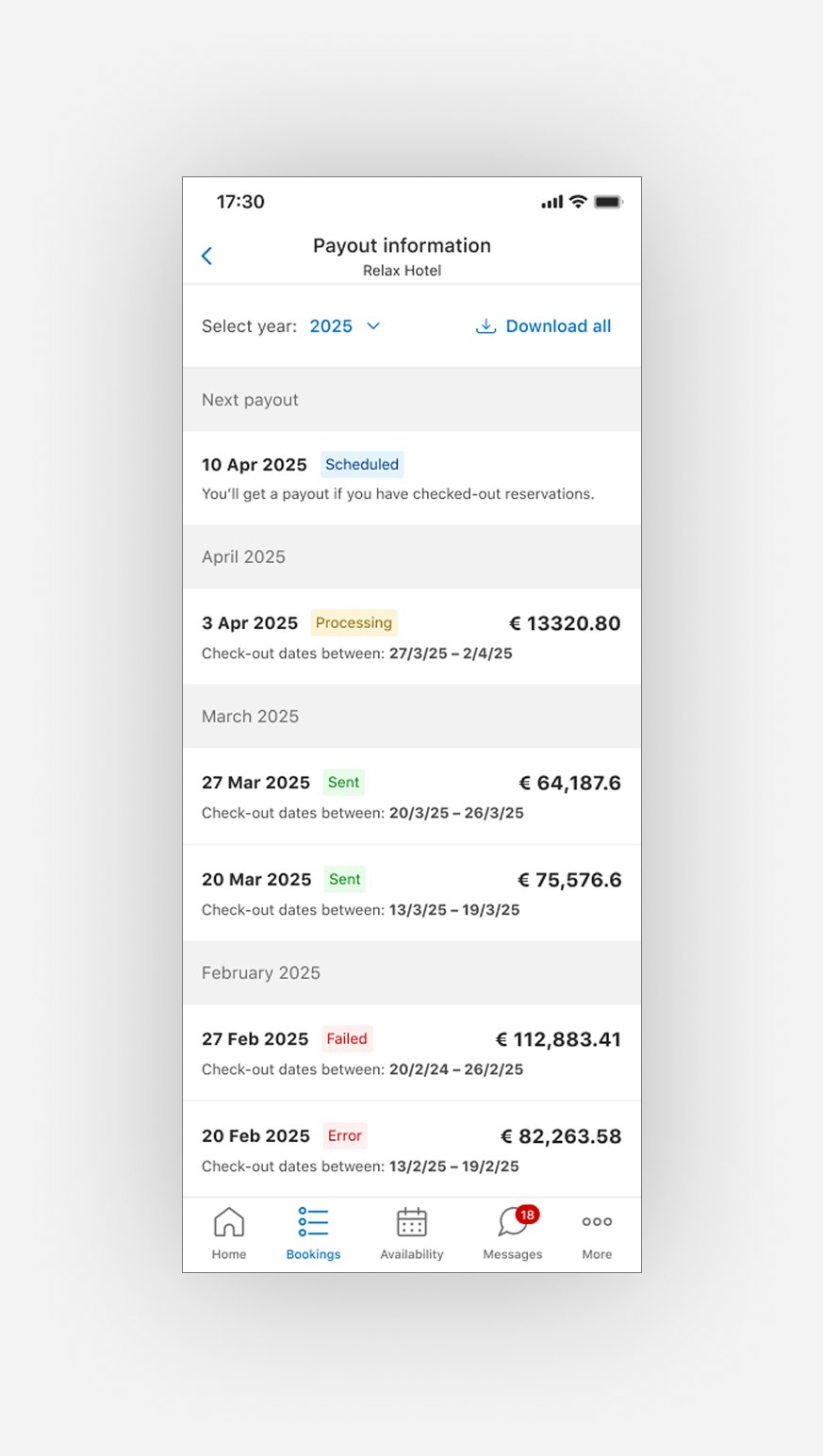
Solution: redesigned the Payout Info view by converting dense desktop tables into native mobile cards with itemized fee breakdowns, real-time status tracking, and booking-level reconciliation.
Outcome: usability testing confirmed partners could navigate fee breakdowns unassisted, leading to a 5% reduction in payout-related support tickets during A/B testing.
Reflection
Endless native vs. webview debates: we went back and forth on speed vs. experience, but ultimately chose native for critical financial workflows because user trust and seamless performance were worth the higher maintenance effort.
Fighting for data and research: with the central research team booked, we had to rely on indirect data, which made it really tough to build strong business cases for several of our best ideas.